 Custom Motorcycles Baggers, Choppers, Cruisers, Street Bikes, Trikes, Oldskool Or Newskool Motorcycles

View Von Dutch Moto Guzzi Falcone Photo Gallery
The Von Dutch Moto Guzzi Falcone is a custom built around contrast: a 500cc single-cylinder engine and exposed mechanical hardware sit beneath an unusually smooth black fiberglass shell. Dick Cormany’s machine looks less like a conventional period special than a carefully resolved exercise in motorcycle coachwork, with gold pinstriping providing the only strong color against the gloss-black body.
A streamlined shell for a mechanical Guzzi
Cormany reportedly bought the used Falcone in 1961 and rode it for a year before beginning a customization that occupied roughly five years and nearly 5,000 hours. The rear fender shroud was developed from a mold made directly on the motorcycle, then refined through a female mold. That process produced the flowing tail section, which extends the tank’s visual line rearward and conceals much of the practical hardware without making the motorcycle appear heavy.
The stock fuel and oil tanks were retained, giving the center of the bike a familiar Guzzi shape. Around them, however, the new bodywork creates a unified silhouette: a long, low seat, a broad rear cowl and a compact front nacelle. The black paint was applied by Kenny Howard, better known as Von Dutch, whose fine gold line follows the edges of the panels and makes the complex contours legible.
The front end is the defining detail
Two small-diameter headlights sit side by side inside the hand-shaped nacelle. Their paired arrangement gives the Falcone a distinctive face, while the narrow gold outline ties the nacelle to the front fender and tail. The source account says each lamp has its own switch at the rear of the nacelle and can be adjusted for elevation while riding, an unusually detailed approach to a component that is often treated as a purely cosmetic feature.
From the side, the silver-finished frame and fork provide a deliberate break from the dark bodywork. Cormany stripped the frame and had it cadmium plated; the reported finishing work was extensive enough to require hand removal of plating stains. The polished and chromed engine components continue that bright mechanical theme, leaving the finned single and its large circular flywheel visually exposed below the tank.
Details made for use, not just display
The modified handlebars and replacement control levers suit the Falcone’s compact proportions, while the racing-style seat keeps the top line clean. It is not simply fixed in place: a spring-loaded latch operated from the rear fender secures it, and the space below is reported to hold tools, gloves and a light jacket. That practical storage is a small but telling counterpoint to the highly sculpted exterior.
The rear view shows how much attention went into the underside. The tail finishes in a compact red lamp, the exhaust remains clearly visible, and the spoked wheels and bright frame keep the motorcycle from becoming a sealed-off sculpture. The result is a custom that makes its bodywork prominent without hiding the engineering that gives the Falcone its character.
Recognition for an individual direction
Cormany’s Falcone was reportedly awarded Best Street Custom at the 1971 Cycle World Show. A contemporary Cycle World account praised its original combination of the Guzzi’s engine and suspension components with a sleek fiberglass shell. That description still captures the bike’s appeal: the build does not imitate a factory racing motorcycle or a familiar chopper formula. It reshapes the Falcone around a single, coherent idea and lets the machine’s contrasting surfaces do the visual work.
Source: Classic Throttle
Photo Gallery
D

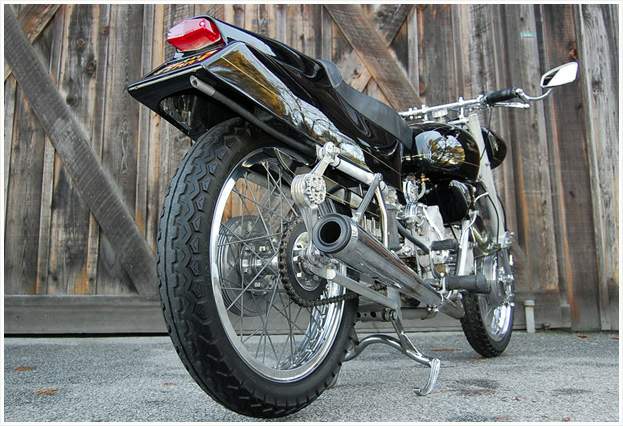 ick Cormany, a Numerical Control Programmer, built this gorgeous Guzzi over a five-year period. Purchased used in 1961 for the sum of $574 from California Moto Guzzi dealer Branch Motorcycle Sales in Los Angeles, Mr. Cormany rode his Falcone for a year before spending close to 5000 hours on the customization process.