 Custom Motorcycles Baggers, Choppers, Cruisers, Street Bikes, Trikes, Oldskool Or Newskool Motorcycles

View Mostro Della Strada: StradaFab’s Titanium-Frame Ducati Monster S4RS Photo Gallery
The Ducati Monster S4RS already combines a trellis chassis, Öhlins suspension and Brembo brakes with a compact, aggressive silhouette. StradaFab’s Mostro Della Strada takes that formula in a more technical direction, replacing the original steel frame with a fabricated titanium structure while reshaping the rear of the motorcycle around a lightweight carbon-fiber seat unit.
A frame built to change the proportions
Randy Martin began with a relatively low-mileage Monster S4RS and used the motorcycle as the reference for a new frame. According to Martin’s account, StradaFab first built a mild-steel welding jig so the titanium chassis could reproduce the stock frame’s mounting points. The new tubes are larger in diameter than the originals, both to address titanium’s greater flex and to give the Ducati a more substantial visual presence.
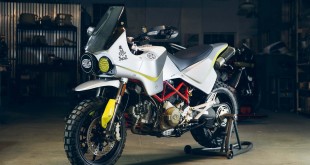
The result is easy to read in the finished motorcycle. The unpainted frame stands out against the black tank and tail, and its broad intersecting tubes make the chassis a primary design feature rather than something hidden beneath the bodywork. StradaFab reports a frame weight of 15 pounds compared with 28 pounds for the stock part; those figures are builder-supplied claims rather than independently verified measurements.
Carbon bodywork and a cleaner tail
The café-racer influence is concentrated at the rear. A carbon-fiber seat pan supports a slim, stepped seat and lets the tail taper sharply behind the tank. The part was formed over a shaped foam mold, then laminated and vacuum-bagged, with additional foam-and-carbon bracing bolted to the frame. Jet Black Metallic paint and a silver stripe keep the bodywork restrained, allowing the titanium and the mechanical components to provide most of the contrast.
Small fabrication details complete the conversion. Clip-on bars made the standard headlight bracket unsuitable, so StradaFab produced a titanium replacement that places the gauges beneath the top triple clamp and lowers the headlight by about two inches. A matching titanium bracket carries the tail light and signals, preserving the abbreviated rear profile without leaving the lighting hardware as an afterthought.
Performance parts left deliberately familiar
Not every system was changed. The stock Brembo brakes and Öhlins suspension were retained, a sensible choice given the quality of the S4RS equipment. Rizoma rear-sets, Driven clip-ons, Rizoma grips and mirrors, and CRG levers revise the rider interface without overwhelming the original Ducati character.
A Quat-D Ex-Box exhaust and StradaFab carbon clutch cover add more visible individuality. Martin reported that the exhaust worked with the stock ECU and saved approximately 10 pounds. The build also received a 14-tooth front sprocket, intended to make the engine more manageable in town rather than chase a headline top-speed figure.
A Monster defined by its structure
StradaFab’s reported completed weight is 364 pounds dry, with the builder describing the motorcycle as roughly 40 pounds lighter than stock. Whether or not those figures are independently confirmed, the bike’s central idea is clear: Mostro Della Strada is not a styling exercise placed over an unchanged chassis. Its visual identity comes from the frame itself, with the carbon tail, lowered front-end hardware and exposed mechanical details all reinforcing that decision.
Source credit: The Kneeslider and StradaFab.
Photo Gallery